Ten Years of My Worst Writing Just Became My Favorite Art Project
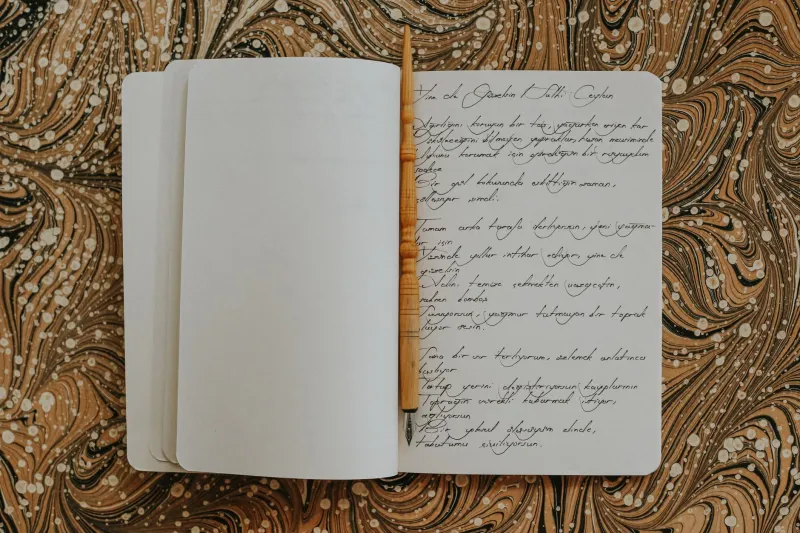
Somewhere in a cardboard box in my mom's garage in Ohio sits a spiral notebook with a glittery cover that says DREAM BIG. Inside that notebook is a fourteen-year-old's version of a novel, and it is catastrophic. The protagonist is named Raven. Raven has purple eyes. Raven is described, in the first chapter, as "not like other girls, but in a cool way."
I reread it last month. On purpose. With my face in my hands.
And here's the strange part: by the end of the weekend, that notebook had become one of my favorite things I own. Not because it's good — it is aggressively not good — but because it's the clearest evidence I have that I've grown.
The Cringe Archive
Every creative person has an archive of their worst work. It's unavoidable. If you've been making things for more than a few years, you've got a graveyard: the abandoned blog from 2011 with three posts, the screenplay that dies on page 12, the journal entries where you wrote "I don't know what to write" fourteen separate times as if the repetition might summon an idea.
Most of us bury this stuff. We treat it like evidence of a crime.
I want to make the case that it's actually a measuring tape.
Think about it. How do you know you've improved at anything? You need a baseline. You need the "before" photo. When you renovate a kitchen, you take pictures of the ugly linoleum first. Your old writing is the ugly linoleum of your creative life, and being embarrassed by it is the entire point.
What Rereading a Decade Actually Felt Like
I broke the experience into eras, like a very sad museum tour.
Years one through three were pure, unfiltered sincerity. Everything I wrote was trying SO hard. There were adjectives stacked three deep. There was a metaphor about autumn leaves falling that I'm still not fully over. But buried in the overwriting was something I'd forgotten: I was fearless. I wrote like nobody was watching because nobody was watching.
Years four through six were the imitation era. You can watch me discover David Foster Wallace and immediately start writing footnotes inside my footnotes. There's a blog post where I used the word "liminal" four times in two paragraphs. I was wearing other people's voices like borrowed jackets that didn't fit.
Years seven through nine were the self-conscious era. This is where the drafts go to die. I started probably forty pieces and finished maybe six. Every entry is hedging, qualifying, apologizing in advance. "This is probably dumb, but—" shows up so often it could be a drinking game.
Year ten is where something shifted. The writing got plainer. Shorter sentences. Fewer fireworks. And the weird thing is, that's when other people started responding to it.
The Embarrassment Is the Data
Here's the insight I want you to take from this, because it's the only part that matters: the stuff that makes you wince marks exactly where you grew.
You can't be embarrassed by your old work and still be at the same skill level. Embarrassment is your taste arriving before your ability caught up — and then, a few years later, your ability finally showing up too. The gap between what you made and what you can now hear was wrong in it? That gap IS growth. You can literally point at a bad sentence and say "there, that's where I learned something."
The writers I worry about aren't the ones cringing at their old journals. It's the ones who reread last year's work and feel nothing. If everything you've ever made still seems fine to you, you've stopped moving.
Do Your Own Excavation (A Modest Proposal)
If you've got old work gathering digital dust, I'm asking you to spend one afternoon with it. Not to fix it. Not to publish it. To read it like an archaeologist.
A few ground rules that helped me:
- Don't edit. The second you pick up a red pen, you turn a time capsule into a chore.
- Read in order. The trajectory is the story. Jumping around hides the throughline.
- Say thank you to past-you. Out loud, if you're brave. That kid with the glitter notebook kept writing so that you could. The least you owe them is not laughing at Raven's purple eyes.
(Okay, I laughed at the purple eyes a little. Past-me would've laughed too. That was the whole vibe.)
Keep the Receipts
I've started keeping everything now. Every bad draft, every half-formed idea, every journal entry that reads like a hostage note. Not because it's precious, but because in five years it'll be a ruler.
Your worst work isn't a monument to who you failed to be. It's a receipt proving how far you've already come — signed, dated, and cringe-worthy in all the right places.
Go find your glitter notebook. It's doing more for you than you think.