Forty-Seven Dollars, Six Abandoned Dreams: What a Pawn Shop Taught Me About Finishing Other People's Business
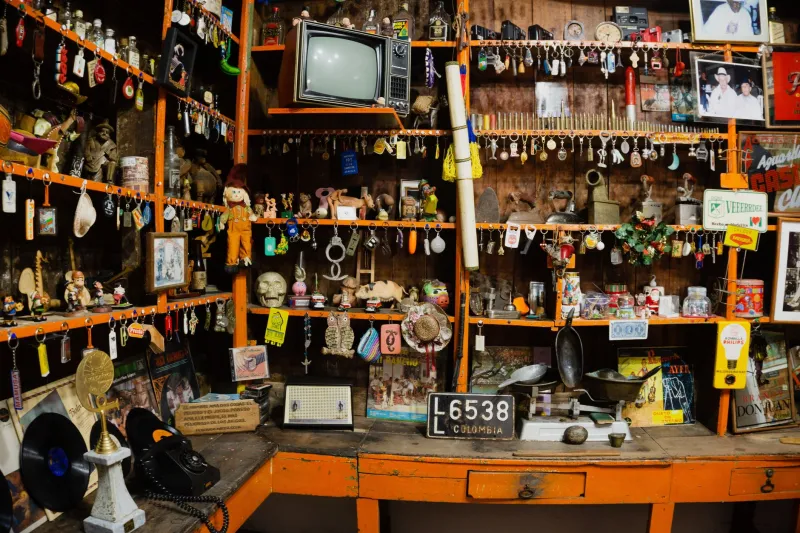
There's a moment in every pawn shop where you stop seeing merchandise and start seeing evidence. The row of guitars isn't inventory — it's a wall of New Year's resolutions that made it to February and then got traded for grocery money. The exercise equipment is a guilt economy. The display case of watches is a museum of anniversaries that ended somehow.
I've written before about outsourcing my creative decisions to dice, to strangers, to a grocery list. But this experiment felt different, because this time I wasn't outsourcing to randomness. I was outsourcing to regret.
The Rules of the Game
Here's what I did. One Saturday afternoon, I drove to a pawn shop in a strip mall outside Columbus — the kind of place with a parrot in a cage by the register and a hand-lettered sign that says NO REFUNDS, NO EXCEPTIONS, NO LECTURES. I gave myself forty-seven dollars, cash, and one rule: buy whatever objects felt like they carried the most emotional weight per dollar. Not the most valuable. The heaviest.
I came home with six things:
- A Yamaha acoustic guitar with a worn patch on the body where somebody's arm clearly rested for hundreds of hours — $40 was too much, so I haggled a bundle.
- A regional bowling league trophy, third place, engraved "DENNIS — 2011."
- A half-finished embroidery kit depicting a lighthouse, roughly two-thirds complete, the needle still threaded.
- A metal detector that someone had clearly modified with aftermarket parts.
- A harmonica in the key of C, well-used, with a small dent.
- A journal — blank, leather-bound, never written in. A gift, probably. The good kind of gift that becomes a burden.
The deal I made with myself: one project per object, one object per month, for six months. And the project had to honor whatever the object was trying to be before its person gave up on it.
Month One: The Guitar That Already Knew What It Wanted
The guitar was the easy one and the hard one at the same time. Easy because I play. Hard because the worn patch told me its previous owner played better — or at least longer, more devotedly, before life intervened in whatever way life intervenes.
I recorded an EP using only that guitar and named it after the pawn shop's parrot. Here's the thing I can't shake: guitars are maybe the only object in America that people buy in a state of pure optimism and sell in a state of pure practicality. Nobody pawns a guitar because they stopped loving music. They pawn it because rent is due. Every note I played on it felt a little like finishing somebody's sentence.
Dennis and the Trophies We Leave Behind
The trophy was the emotional center of the whole experiment, and I didn't expect that.
Dennis took third place in something in 2011. Somebody — Dennis? His teammate? His ex-wife clearing out the garage? — decided that this object no longer deserved shelf space. And now it was mine, a stranger's, for eleven dollars.
I didn't want to make art about Dennis exactly. That felt parasitic. So instead I made art for the premise of Dennis: a short film, shot on my phone, about a third-place finisher giving an acceptance speech to an empty living room. It's two minutes long. It's the most honest thing I've made all year. Third place is where most of us live, and we almost never build monuments to it.
The Lighthouse, Two-Thirds Finished
The embroidery kit broke my brain a little.
Someone stitched maybe forty hours into this thing. Sky, water, the base of the tower — all done in careful, even stitches. Then they stopped. Maybe the lighthouse itself was the hard part. Maybe it's always the lighthouse.
I don't embroider. I made a decision early on that finishing it in my own clumsy style was more honest than learning the craft properly, because whoever started it wasn't a master either. My stitches are wrong. The lighthouse is slightly drunk. It hangs in my studio now under the title Finished Badly on Purpose, With Apologies to the Original Artist. It might be my favorite object I own.
What Inheriting a Dream Actually Does to You
Here's my thesis, six months in: every abandoned hobby is a message in a bottle, and pawn shops are just beaches with price tags.
The metal detector guy — I think about him too. He modified that thing. He read forums. He had opinions about coil sizes. And then one day he carried it into a strip mall and converted his curiosity into cash. When I took it to a creek outside town and found, over four weekends, two pull-tabs, a 1964 dime, and a horseshoe, I understood the addiction and the exit. Some dreams don't fail. They just get outvoted by the rest of a life.
The blank journal was the cruelest object and produced the best project: I filled it in thirty days with the worst, most unfiltered morning pages of my life, then read selections from it aloud at an open mic, which is either performance art or a war crime depending on who you ask.
Try It Before You Quit Something Else
I'm not saying pawn shops are the answer. I'm saying that your next project doesn't have to come from inside you, because inside you is a limited well that you've been pumping dry. Sometimes the well is a stranger's. Sometimes it's Dennis's.
Forty-seven dollars. Six months. Six objects that outlived their owners' ambitions and got a second act in my hands. The parrot at the register watched the whole thing happen and never once looked impressed, which, honestly, is the correct artistic criticism for everything I've ever made.
Go finish somebody's lighthouse. The needle's still threaded.