Your Brain Keeps Weird Hours: A Field Guide to the Midnight Idea Problem
There's a specific flavor of despair that comes from lying in bed at 3 a.m., struck by what is unquestionably the best idea of your life, and knowing — knowing — that by morning it will be gone. Not faded. Gone. Evaporated like it was never there.
I've lost count of the number of half-novels, business empires, and Grammy acceptance speeches I've composed between midnight and dawn, only to wake up holding nothing but a vague sense that I'd been onto something. If you've experienced this, congratulations: your brain is working exactly as evolution intended. Unfortunately, evolution never consulted your calendar.
The Night Shift Nobody Asked For
Here's the annoying science part, and I'll keep it short. During the day, your prefrontal cortex — the uptight office manager of your brain — runs a tight ship. It filters, edits, judges, says no. At night, especially in that liminal zone between awake and asleep, the office manager goes home. The filter lifts. Random concepts start shaking hands with each other in the parking lot.
This is why midnight-you thinks a podcast about competitive dog grooming narrated entirely by a synthetic voice is a fantastic idea. Sometimes midnight-you is wrong. But sometimes midnight-you is the only one brave enough to say the thing that daytime-you would've immediately strangled in the crib.
The problem isn't that the ideas are bad. It's that they show up without an appointment, at an hour when your body has the coordination of a wet paper towel.
The Capture Problem
So the real skill isn't having ideas. Everyone has ideas. The real skill is trapping them before they scurry back into the walls.
I've tried everything, and here's my honest ranking of the midnight capture arsenal:
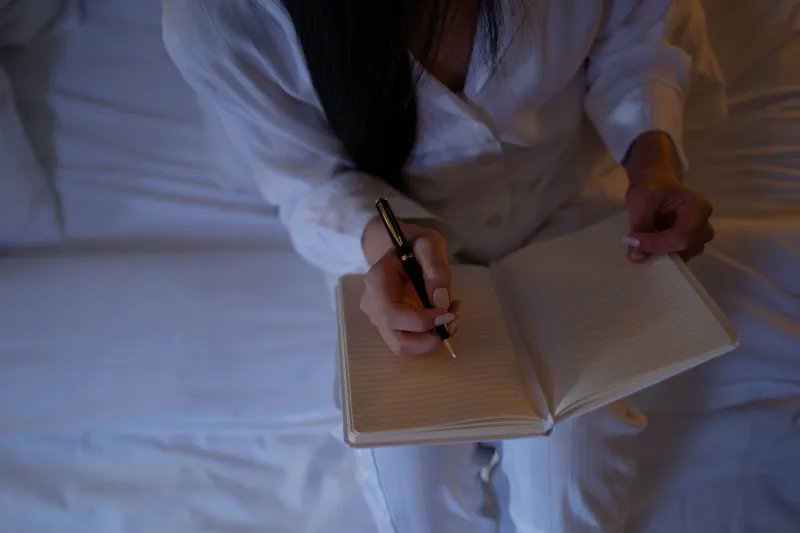
The bedside notebook. The classic. Works great until you wake up and discover you've written what appears to be "the crow knows about the letter??" in handwriting that suggests a raccoon held the pen. Still, a notebook is undefeated for reliability. No battery, no screen glow, no temptation to "just check one thing."
Voice memos. The modern savior. Whispering an idea into your phone at 3:17 a.m. feels unhinged and is therefore probably art. The downside: future-you, listening back, will hear ninety seconds of mumbling, a car passing, and the phrase "and that's the whole thing, really." The whole thing what? Past-you took it to the grave.
The dream journal. Highest risk, highest reward. Most dreams are nonsense — mine mostly involve being late for a flight through a mall that is also my childhood home. But every so often, a dream hands you a fully formed image or scene that no waking mind would've dared invent. Write it down within ninety seconds of waking or it's gone. Dreams have the retention rate of a goldfish with a concussion.
Insomnia Built This Town
You're in decent company, by the way. A suspicious number of the people we canonize did their best work while the rest of America was asleep.
Marcel Proust wrote much of In Search of Lost Time in a cork-lined bedroom on a nocturnal schedule that would concern any primary care physician. Miles Davis reportedly stayed up for days at a stretch during his most inventive periods, chasing sounds that only existed at that hour. And the whole beat generation ran on all-nighters — Kerouac famously wrote On the Road in a three-week caffeinated fever, feeding on the hours when the critical mind clocks out.
Even outside the arts, the pattern holds. The inventor's garage, the writer's kitchen table at 2 a.m., the musician's four-track in a dark apartment — a huge chunk of American creative mythology is just insomnia with a good publicist.
Make Peace With the Schedule
Here's my actual advice, for what it's worth. Stop fighting the hours and start staffing them. Put a notebook and a pen literally on the nightstand — not in the drawer, on it. Leave your phone's voice memo app on the home screen. If an idea wakes you up, you have one job: get it out of your head and into something external within two minutes. Don't evaluate it. Don't improve it. Capture, then sleep.
And in the morning, read what you wrote before you judge it. Some of it will be garbage. Some of it will be the crow and the letter, whatever that means. But once in a while, you'll find something that makes you sit up straight and think: huh, past-me was onto something.
Your best ideas don't keep business hours. Neither should you.