The Quarter Knows: What Happened When a Diner Gumball Machine Ran My Studio for a Season
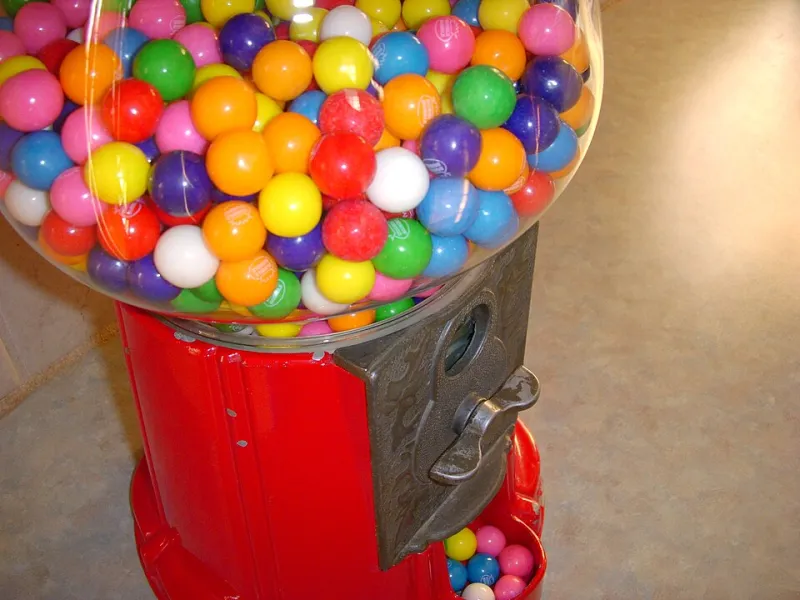
Photo: Julie Alexander from U.S., CC BY 2.0, via Wikimedia Commons
The machine sits by the register at the Wagon Wheel Diner off Highway 63, wedged between a rack of sunglasses and a tip jar that mostly contains foreign coins and one guitar pick. It looks like a standard gumball globe — red cast-iron base, cloudy plastic dome — except instead of gum, it dispenses little plastic capsules, and instead of candy, the capsules contain folded slips of paper with handwritten instructions.
Nobody knows who stocks it. The waitress, Deb, has worked there for nineteen years and claims she's never seen anyone refill it. The capsules just keep coming, like the machine has its own supply chain, its own opinions.
I put a quarter in on a Tuesday in October because I was stuck. Not bored-stuck. Stuck-stuck. The kind where you've got a studio full of materials and absolutely no conviction about any of them. The slip of paper said, in surprisingly tidy cursive: MAKE SOMETHING OUT OF CARDBOARD. BLUE ONLY.
So I did. And then I kept going back.
The Rules I Made Up and Then Obeyed Like Law
Here's the contract I signed with a vending machine: every major creative decision for the quarter — roughly thirteen weeks — had to come from a capsule. Medium, color palette, title, and, in the most financially irresponsible move of my career, pricing. Each capsule was a quarter. I set a hard budget of twenty dollars for the whole experiment, which meant the machine had roughly eighty votes in how my season would go.
The pricing capsules were the wildest part. Some just said numbers: $140. $60. $2,500. One said "TRADE ONLY." One said "WHATEVER YOUR GUT SAYS, SUBTRACT 40%." I sold a cardboard-and-blue construction that I'd labored over for two weeks for sixty bucks, because the machine said so, to a guy who bought hay equipment for a living and told me it reminded him of a barn fire he saw as a kid. He seemed happy. I was numb. It was great.
What Surrender Actually Feels Like
People romanticize letting go of control, but let me describe the Tuesday-morning reality of it: you wake up, you don't get to want anything. The machine wants a charcoal portrait of a mailbox. The machine wants it titled "KEVIN." The machine wants it priced at eleven dollars.
And here's the strange part — the work got looser. Better, even. When every choice is outsourced, you stop defending your taste. There's no ego to protect because the ego didn't make any of these decisions. A stranger's handwriting in a capsule picked the palette, so if the painting fails, the painting fails, and you just feed the machine another quarter and try again. Failure gets cheap. Cheap failure is the most underrated studio tool I've ever found.
By week six I'd made things I would never have made: a series of highway overpasses rendered in crayon and wood stain, a taxidermy-adjacent assemblage involving a crockpot, a zine of nothing but diner receipt poetry priced at "ONE HONEST COMPLIMENT."
Week Nine, or: The Cheating Begins
Then came the capsule that said NO ART THIS WEEK. FIX YOUR LEAKY FAUCET.
And I stood there in that diner, holding a quarter and a piece of paper, and I thought: absolutely not. I have deadlines. I have a show. I do not answer to a plastic globe maintained by a ghost.
I made art that week anyway. And I told myself it was a one-time thing. But once you've rigged the machine in your head — once you've decided that some capsules count and some don't — you're back in charge, and the whole spell starts to weaken. The next disagreement came fast. Then the next. By week ten I was standing at the machine doing something I'm not proud of: shaking it slightly before inserting my quarter, angling for the capsule I wanted.
I was rigging a rigged system. Think about that. I had handed my entire creative quarter to chance, and then I cheated chance, because deep down I still believed I knew better.
So How Much Control Do You Actually Need?
Here's my honest conclusion, three months and roughly sixty capsules later: a creative career requires almost no control over what you make and almost total control over whether you keep making it.
The machine proved that medium, palette, title, and price are all survivable decisions — any of them can be wrong and the work goes on. What the machine couldn't give me was the showing up. The drive down Highway 63. The quarter in my hand. That part was always mine, and I could feel the difference between the weeks I surrendered the what and the week I tried to surrender the whether. The second one broke the experiment.
The machine is still there. Deb still doesn't know who fills it. Last month I went back — not for a decision, just for pie — and I put in a quarter anyway, for old times' sake. The slip said: YOU ALREADY KNOW WHAT TO MAKE. GO HOME AND MAKE IT.
Either the machine has a sense of humor, or whoever stocks it has been paying attention. I drove home and made the thing I'd been avoiding since October. The machine, as far as I'm concerned, can take partial credit.